
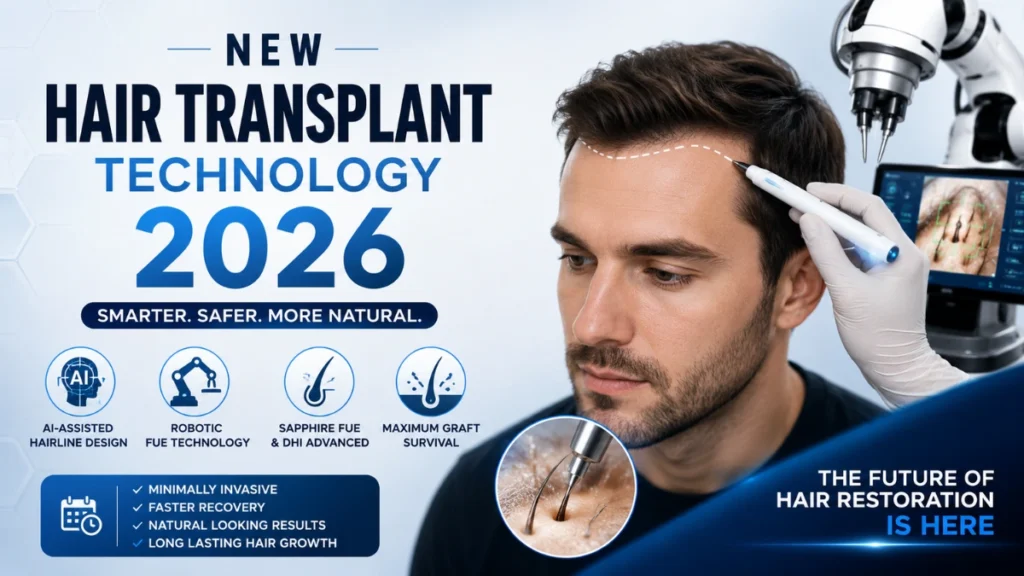

New Hair Transplant Technology 2026: Hair loss affects millions of men and women worldwide, and the demand for advanced hair restoration has never been higher. In 2026, new hair transplant technology is transforming the industry with AI-assisted planning, robotic precision, stem cell research, enhanced graft survival techniques, and minimally invasive procedures that deliver natural-looking results with shorter recovery times.
Unlike traditional hair transplant methods, today’s innovations focus on improving accuracy, preserving donor hair, reducing scarring, and creating denser, more natural hairlines. Whether you’re considering your first procedure or exploring the latest advancements, understanding these technologies can help you make an informed decision.
New Hair Transplant Technology 2026
| Feature | Details (2026) |
|---|---|
| Technology | AI-Assisted Planning, Robotic FUE, Sapphire FUE, DHI |
| Procedure Type | Minimally Invasive Hair Transplant |
| Best For | Male & Female Pattern Hair Loss, Beard & Eyebrow Restoration |
| Recovery Time | 7–14 Days (Initial Healing) |
| Visible Hair Growth | 3–6 Months |
| Final Results | 12–18 Months |
| Scarring | Minimal with FUE & DHI Techniques |
| Anaesthesia | Local Anaesthesia |
| Procedure Duration | 4–8 Hours (Depending on Grafts) |
| Latest Trends (2026) | AI Hairline Design, Robotic Extraction, Exosome Therapy, Advanced Graft Preservation |
| Success Rate | High when performed by an experienced hair transplant surgeon |
| Result Duration | Long-lasting with proper aftercare |
Why Hair Transplant Technology Is Advancing in 2026
Modern patients expect more than just hair growth. They want:
- Natural-looking hairlines
- Minimal downtime
- Less discomfort
- Higher graft survival
- Better density
- Faster healing
- Long-lasting results
To meet these expectations, leading hair transplant clinics are investing in AI, robotics, regenerative medicine, and advanced imaging technologies.
Top New Hair Transplant Technologies in 2026
1. AI-Assisted Hairline Design
Artificial Intelligence has become one of the biggest trends in hair restoration.
How It Works
AI software analyzes:
- Face shape
- Age
- Hair density
- Hair direction
- Future hair loss patterns
- Donor availability
The system recommends a personalized hairline that looks natural both today and years into the future.
Benefits
- Highly customized planning
- Improved facial symmetry
- Better long-term aesthetics
- Reduced planning errors
2. Robotic FUE Hair Transplant
Robotic Follicular Unit Extraction (FUE) continues to evolve in 2026.
Robotic systems assist surgeons by identifying healthy follicles and extracting them with exceptional precision while preserving surrounding tissue.
Advantages
- Consistent graft extraction
- Less donor damage
- Faster procedures
- Improved graft quality
- Reduced human fatigue
Robotic technology complements experienced surgeons rather than replacing them.
3. Sapphire FUE Technology
Sapphire FUE remains one of the most preferred methods due to its precision.
Instead of steel blades, surgeons use sapphire blades to create recipient channels.
Benefits
- Smaller incisions
- Faster healing
- Reduced bleeding
- Less swelling
- Higher graft density
- More natural hair growth angles
4. DHI (Direct Hair Implantation) 2.0
Direct Hair Implantation has become even more refined.
The updated approach uses improved implantation pens that allow surgeons to implant follicles directly without first creating recipient sites.
Benefits
- High implantation accuracy
- Better graft survival
- Natural hair direction
- Minimal tissue trauma
- Faster recovery
5. Stem Cell-Based Hair Restoration Research
Stem cell therapy remains one of the most promising areas in hair restoration.
Researchers are investigating methods to:
- Stimulate dormant follicles
- Improve healing after transplantation
- Increase hair thickness
- Support donor hair regeneration
While stem cell-assisted treatments are advancing rapidly, fully regenerative hair cloning is still under clinical research and is not yet widely available for routine treatment.
6. Exosome Therapy After Hair Transplant
Exosome therapy has gained popularity as an adjunct treatment.
Exosomes are microscopic extracellular vesicles containing signalling molecules that may support tissue repair.
Potential benefits include:
- Faster healing
- Reduced inflammation
- Improved scalp recovery
- Better graft support
- Enhanced hair quality
Patients should discuss the current evidence, regulatory status, and suitability with their surgeon before choosing this option.
7. Platelet-Rich Plasma (PRP) Optimization
PRP continues to be used alongside hair transplants.
Recent protocols focus on:
- Better platelet concentration
- Improved injection techniques
- Individualized treatment timing
PRP may help support healing and existing hair, though results vary between individuals.
8. High-Density Micro Grafting
Surgeons now use advanced microscopes and refined implantation methods to place follicles more efficiently.
Benefits include:
- Fuller appearance
- Improved natural density
- Better spacing
- Reduced trauma
- Enhanced cosmetic outcomes
9. Needle-Free Anaesthesia Systems
Modern clinics increasingly use needle-free or vibration-assisted anaesthesia systems to improve patient comfort.
Benefits include:
- Less discomfort
- Reduced anxiety
- Better treatment experience
- Faster procedure preparation
10. Advanced Graft Preservation Technology
Graft survival depends on proper handling.
New preservation solutions help:
- Maintain hydration
- Reduce cellular stress
- Improve follicle viability
- Support healthier implantation
These advances contribute to improved overall outcomes.
Hair Cloning: Is It Available in 2026?
Hair cloning is one of the most discussed developments.
Scientists aim to multiply hair follicle cells in laboratories and create new follicles for transplantation.
Current Status
Hair cloning is still under research and is not yet a commercially established treatment in routine clinical practice.
If successful in the future, it could:
- Reduce donor limitations
- Increase available grafts
- Improve treatment options for extensive hair loss
Comparison of Hair Transplant Technologies
| Technology | Invasiveness | Healing | Precision | Natural Results |
|---|---|---|---|---|
| Traditional FUT | Moderate | Moderate | Good | Good |
| Standard FUE | Low | Fast | High | Very Good |
| Sapphire FUE | Low | Faster | Very High | Excellent |
| DHI | Low | Fast | Excellent | Excellent |
| Robotic FUE | Low | Fast | Excellent | Excellent |
| AI-Assisted Planning | Planning Tool | N/A | Exceptional | Highly Personalized |
Who Can Benefit from New Hair Transplant Technology?
Modern techniques may be suitable for:
- Men with male pattern baldness
- Women with thinning hair
- Beard restoration candidates
- Eyebrow restoration patients
- Scar correction cases
- Individuals seeking hairline refinement
Eligibility depends on factors such as donor hair quality, scalp health, and the cause of hair loss.
Benefits of 2026 Hair Transplant Innovations
Modern technologies offer:
- More natural hairlines
- Better graft survival
- Less downtime
- Minimal scarring
- Faster recovery
- Higher patient comfort
- Improved precision
- Better long-term cosmetic results
What Should You Ask Before Choosing a Clinic?
Before undergoing treatment, ask:
- Which transplant technique do you recommend?
- Is the surgeon performing the key stages of the procedure?
- How many similar procedures have you completed?
- What results can I realistically expect?
- What are the potential risks and complications?
- What post-operative care is included?
- Can I see before-and-after photographs of previous patients?
Hair Transplant Recovery in 2026
Day 1–3
- Mild swelling
- Tiny scabs
- Rest recommended
Week 1
- Scabs begin to fall naturally
- Gentle washing
Month 1
- Temporary shedding of transplanted hairs (“shock loss”) may occur
Months 3–6
- New hair growth gradually becomes visible
Months 9–12
- Significant improvement in density
12–18 Months
- Final results continue to mature for many patients
Recovery timelines vary based on the procedure and individual healing.
Future Trends in Hair Restoration
Emerging developments include:
- AI-driven scalp analysis
- 3D hairline simulation
- Advanced robotic assistance
- Enhanced regenerative therapies
- Improved graft preservation solutions
- Personalized treatment planning using predictive analytics
- Ongoing research into follicle regeneration
FAQs
1. What is the latest hair transplant technology in 2026?
The latest hair transplant technologies in 2026 include AI-assisted hairline design, robotic FUE, Sapphire FUE, advanced DHI techniques, improved graft preservation solutions, and regenerative therapies such as PRP and exosome-assisted treatments. These innovations aim to provide more natural-looking results with faster recovery.
2. Is robotic hair transplant better than traditional FUE?
Robotic hair transplant offers greater precision in follicle extraction and can reduce damage to surrounding tissue. However, the success of the procedure still depends largely on the surgeon’s expertise, proper planning, and post-operative care.
3. What is AI-assisted hair transplant planning?
AI-assisted planning uses advanced software to analyse facial features, hair density, donor area, and future hair loss patterns. It helps surgeons design a personalised hairline that complements the patient’s facial structure and long-term appearance.
4. Is hair cloning available in 2026?
No. Hair cloning remains under clinical research and is not yet available as a standard treatment. While researchers continue to make progress, commercial hair cloning has not been widely introduced.
5. Which hair transplant technique provides the most natural results?
Sapphire FUE, Direct Hair Implantation (DHI), and robotic-assisted FUE are among the most advanced techniques in 2026. The best option depends on the patient’s hair loss pattern, donor hair quality, and treatment goals.
6. How long does it take to recover after a hair transplant?
Most patients can resume light daily activities within a few days. Initial healing usually occurs within 7–14 days, while noticeable hair growth typically begins after three to four months. Final results are generally visible within 12 to 18 months.
7. Are modern hair transplants permanent?
Yes. Transplanted hair follicles are usually taken from areas that are genetically resistant to hair loss, making the results long-lasting. However, natural hair surrounding the transplanted area may continue to thin over time.
8. Is a hair transplant painful?
Modern hair transplant procedures are performed under local anaesthesia, making the treatment relatively comfortable. Some mild soreness or swelling may occur after the procedure, but it usually subsides within a few days.
9. Can women undergo hair transplant surgery?
Yes. Hair transplantation can be an effective option for women experiencing hair thinning, traction alopecia, or hair loss due to certain medical conditions, provided they have a suitable donor area.
10. How much does a hair transplant cost in 2026?
The cost varies depending on the clinic, surgeon’s experience, transplant technique, number of grafts required, and location. A personalised consultation is the best way to receive an accurate treatment estimate.
11. What should I look for when choosing a hair transplant clinic?
Choose a clinic with experienced surgeons, proven patient results, modern technology, transparent pricing, proper safety standards, and positive patient reviews. Reviewing before-and-after photos and discussing realistic expectations during consultation is also important.
12. Are PRP and exosome therapy necessary after a hair transplant?
PRP and exosome therapies are optional supportive treatments. They may help improve healing and support hair growth in some patients, but they are not mandatory. Your surgeon can recommend whether these treatments are suitable for your individual case.