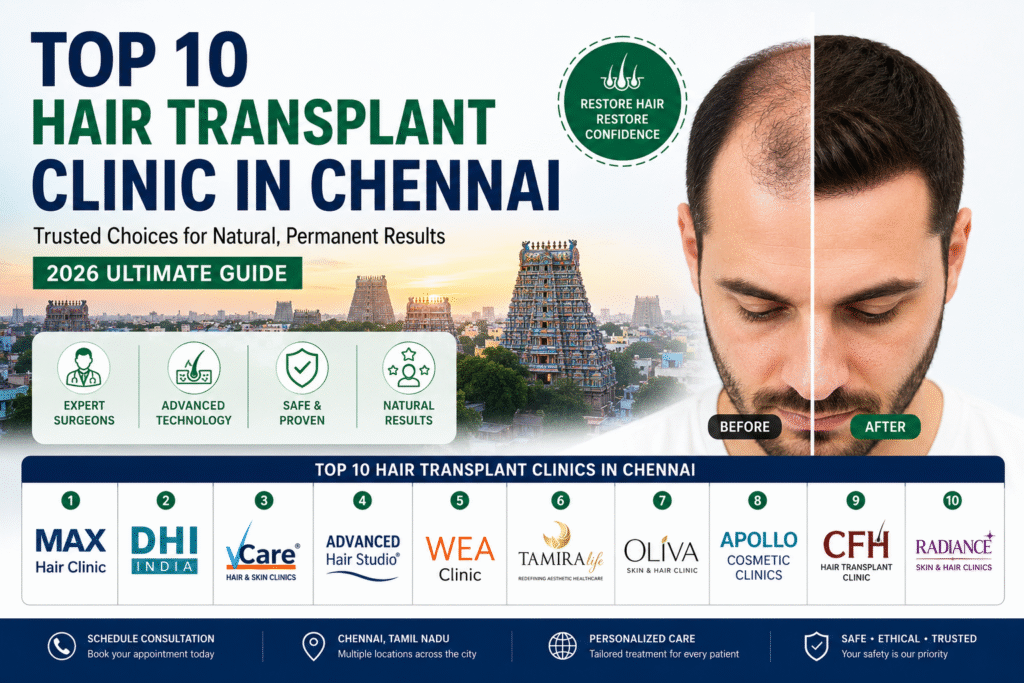

The following selection highlights established or frequently referenced names in Chennai’s hair restoration market. Inclusion doesn’t constitute a medical endorsement, and the numerical order isn’t intended to prove clinical superiority.
Patients should verify current branch information, surgeon availability, credentials, treatment methods, reviews, pricing, and regulatory requirements directly before undergoing treatment.
1. MAX Hair Clinic
MAX Hair Clinic is one of the names that appears in discussions of dedicated hair restoration services in Chennai.
The clinic promotes surgical and non-surgical approaches to hair restoration and markets techniques including Sapphire FUE and related hair treatment options.
For prospective patients, the most important step is to schedule an individual consultation rather than selecting a procedure based only on online information.
Ask the consulting doctor to evaluate your donor area and explain the expected number of grafts, potential density, hairline design, and future hair loss considerations.
It’s also useful to request before-and-after examples involving patients with a hair loss pattern and donor characteristics similar to yours.
When comparing MAX Hair Clinic with other options, consider the experience of the surgeon assigned to your procedure, the doctor’s level of involvement, infection-control standards, and follow-up arrangements.
2. DHI India
DHI India operates a hair restoration clinic in Chennai and promotes its Direct Hair Implantation approach.
The Chennai clinic is associated with hair transplantation as well as additional hair restoration services. Its approach may appeal to patients specifically researching DHI-style implantation.
However, patients should understand that branded techniques aren’t substitutes for individual medical assessment.
During your consultation, ask how the proposed technique differs from conventional FUE in your particular case. You should also understand who will perform follicle extraction and implantation.
Discuss expected graft requirements, donor-area limitations, recovery, potential complications, and realistic density.
Before committing, obtain a written quotation that explains what is included in the treatment package.
3. VCare Hair & Skin Clinics
VCare is a recognisable name in the South Indian hair and skin treatment market and has a presence associated with hair care and hair restoration services.
The broader range of services may be useful for people who haven’t yet established whether surgery is appropriate.
Hair loss can have different causes. Pattern hair loss is only one possibility. Nutritional factors, hormonal changes, certain medical conditions, medications, stress-related shedding, and scalp disorders can also contribute to hair loss.
Therefore, getting an appropriate diagnosis before choosing surgery is important.
If considering a transplant through a multi-service hair and skin provider, confirm the qualifications and experience of the specific surgeon who would perform your procedure.
4. Advanced Hair Studio
Advanced Hair Studio is an established hair restoration brand offering different approaches to hair loss management.
Depending on individual needs, people may investigate surgical transplantation as well as non-surgical hair restoration solutions.
This range can be useful because not everyone experiencing hair loss is automatically a good candidate for transplantation.
For example, a person with an unstable pattern of progressive hair loss may require a different long-term strategy from someone with a well-established pattern and a strong donor area.
When consulting any hair restoration provider, make sure you understand whether the proposed solution is surgical, medical, cosmetic, or non-surgical.
Ask about maintenance requirements and long-term costs as well.
5. WEA Clinic
WEA Clinic is another Chennai-based option appearing in local discussions about dermatology and hair restoration.
Patients considering a dermatology-focused clinic may benefit from a broader evaluation of their scalp and hair loss before discussing transplantation.
This is particularly relevant when the cause of hair loss isn’t obvious.
During an evaluation, discuss your history of hair shedding, family history, medications, previous treatments, and any scalp symptoms.
If transplantation is recommended, ask for a detailed explanation of why you’re considered a suitable candidate.
You should also understand the expected progression of your existing, non-transplanted hair. A transplant can relocate follicles, but it doesn’t necessarily prevent ongoing loss of native hair.
6. Tamira Life
Tamira Life is associated with aesthetic and cosmetic treatment services and has published information about hair transplantation in Chennai.
Its broader cosmetic-care positioning may appeal to patients looking for an aesthetic treatment environment.
Still, the same medical evaluation principles apply.
The quality of a hair transplant should be assessed according to the qualifications of the treating professional, surgical planning, donor preservation, graft handling, hygiene protocols, and aftercare.
A good consultation should also include a realistic discussion about limitations.
If a patient’s donor supply is limited, for instance, promising extremely high density across a large bald area may not be realistic.
Ask to see healed results rather than only photographs taken immediately after implantation.
7. Oliva Skin & Hair Clinic
Oliva is known for dermatology-focused skin and hair services and has a presence in Chennai.
For someone in the early stages of researching hair restoration, a dermatology consultation may help determine the underlying nature of hair loss and whether surgical treatment should even be considered.
Patients should remember that hair transplantation is generally used to redistribute existing follicles. It doesn’t create an unlimited new supply of donor hair.
As a result, donor management is one of the most important elements of long-term planning.
When researching a transplant at any clinic, ask whether the proposed plan accounts for possible future hair loss over the next 5, 10, or 20 years.
8. Apollo Cosmetic Clinics
Apollo’s healthcare network is widely recognised in India, while cosmetic services associated with the brand have included aesthetic procedures and hair restoration-related care.
Patients who prefer treatment connected with a larger healthcare ecosystem may consider investigating available cosmetic and hair transplant services.
However, availability can vary by location.
Always confirm whether hair transplantation is currently performed at the Chennai facility you’re considering and identify the specific surgeon responsible for the procedure.
The reputation of a hospital or healthcare brand shouldn’t replace research into the individual surgeon performing your transplant.
Ask about qualifications, experience, technique, complication management, and follow-up care.
9. CFH Hair Transplant Clinic
CFH is another name associated with specialised hair restoration services in Chennai.
When considering a specialised clinic, examine its approach to hairline design and donor preservation.
Natural-looking hair transplantation requires more than simply filling an empty area with grafts.
The frontal hairline must complement the patient’s age and facial proportions. The direction and angle of transplanted follicles also influence whether the final appearance looks natural.
Request high-quality photographs of fully healed results under consistent lighting.
If possible, examine different angles, including the hairline and donor area.
10. Radiance Skin & Hair Clinics
Radiance Skin & Hair Clinics is another option that patients researching hair and scalp treatments in Chennai may encounter.
A clinic offering both dermatology and hair services can be worth investigating when a patient requires diagnosis before deciding on transplantation.
During the first consultation, explain your complete hair loss history rather than focusing immediately on surgery.
Ask whether any further diagnostic evaluation is necessary and whether your hair loss is stable enough for transplantation.
If surgery is suggested, compare the proposed treatment plan with at least one or two additional qualified medical opinions.
A second opinion can be especially valuable when recommendations differ significantly in graft numbers, hairline position, technique, or cost.
How to Choose the Best Hair Transplant Clinic in Chennai
Finding the right clinic requires more than searching online for the top 10 hair transplant clinic in Chennai and choosing the first result.
Hair transplantation is a medical procedure, so your decision should be based on clinical factors.
Check the Surgeon’s Qualifications
Start by identifying the doctor responsible for your treatment.
Ask for their medical qualifications and relevant surgical or dermatological training. Verify professional registration where applicable.
Most importantly, find out who performs each critical stage of the procedure.
Don’t assume that the doctor you meet during the consultation will personally perform the entire surgery.
Review Relevant Experience
Experience should be considered in context.
Ask how frequently the surgeon performs hair transplantation and whether they regularly treat cases similar to yours.
A patient requiring frontal hairline reconstruction may have different needs from someone seeking crown restoration, beard transplantation, or a corrective procedure.
Examine Before-and-After Results Carefully
Before-and-after photographs can be useful, but they need to be assessed carefully.
Look for consistency in lighting, angle, hairstyle, and image quality.
Ask to see results from cases with similar hair characteristics and levels of hair loss.
Where possible, examine both the recipient and donor areas.
Ask Who Performs the Procedure
This question is extremely important.
Hair transplantation may involve several stages, including donor extraction, recipient-site creation, graft preparation, and implantation.
Ask exactly which stages are performed by the surgeon and which, if any, involve trained assistants or technicians.
The clinic should be transparent about its process.
Evaluate Hairline Design
A dense transplant can still look unnatural if the hairline is poorly designed.
The ideal hairline should account for age, facial structure, existing hair, donor availability, and the expected progression of hair loss.
Extremely low or perfectly straight hairlines aren’t suitable for everyone.
Ask the doctor to explain why a proposed hairline is appropriate for your long-term appearance.
Understand Donor-Area Management
Your donor area is a limited resource.
Once follicles are extracted, they can’t simply be replaced in the donor region.
Overharvesting may create visible thinning or an uneven appearance.
A responsible treatment plan should balance the patient’s desire for density with the need to preserve donor resources.
Compare More Than Price
It’s tempting to choose the cheapest package, especially when clinics advertise per-graft pricing.
However, the lowest quotation isn’t necessarily the best value.
Compare:
- Surgeon’s qualifications
- Surgical experience
- Doctor involvement
- Technique
- Facility standards
- Number of grafts
- Medication
- Follow-up visits
- Aftercare
- Revision policies
A clear written quotation makes comparisons easier.
Hair Transplant Cost in Chennai
Hair transplant costs in Chennai vary considerably.
Some clinic-published guides cite broad ranges, but these shouldn’t be treated as universal market prices. The final amount depends on the patient’s individual needs and the provider.
Factors affecting cost may include:
| Cost Factor | Why It Matters |
| Number of grafts | Larger areas may require more grafts |
| Technique | Different methods can have different pricing |
| Surgeon | Highly experienced surgeons may charge more |
| Complexity | Corrective or advanced cases can be more difficult |
| Facility | Infrastructure and clinical standards affect costs |
| Additional treatment | Some packages include complementary therapies |
| Aftercare | Follow-up services may or may not be included |
Instead of asking only, “How much does a hair transplant cost?” ask for an itemised quotation.
Find out whether the quoted price includes consultation, blood tests, medication, post-operative washing, follow-up appointments, and applicable taxes.
Also be cautious when clinics promise a precise graft count before properly examining your scalp and donor region.
A personalised assessment should generally come first.
What Happens During a Hair Transplant Procedure?
The exact process varies according to the chosen technique and clinical protocol.
However, the patient journey commonly begins with consultation and planning.
Step 1: Consultation
The doctor evaluates the patient’s hair loss pattern, scalp, donor region, medical history, and expectations.
This is the stage to discuss goals and limitations.
Step 2: Treatment Planning
If the patient is suitable for surgery, the doctor develops a treatment strategy.
The proposed hairline may be marked, and the approximate graft requirement is discussed.
Step 3: Pre-Procedure Preparation
The clinic provides instructions for the days leading up to surgery.
Patients should follow medical guidance carefully and disclose all medications and supplements they use.
Step 4: Donor Extraction
Depending on the technique, follicles are harvested from the donor region.
Careful extraction is important to preserve both graft quality and the appearance of the donor area.
Step 5: Recipient-Site Planning and Implantation
The recipient area is prepared according to the planned design.
Grafts are then placed according to the clinic’s technique.
The angle, direction, and distribution of follicles influence the final aesthetic appearance.
Step 6: Post-Procedure Instructions
After surgery, the patient receives instructions covering scalp care, sleeping position, washing, medication, and activities to avoid.
Follow these instructions carefully.
Contact the clinic promptly if you experience symptoms that concern you.
Hair Transplant Recovery and Results
Recovery varies according to the individual, the extent of surgery, and the technique used.
In the early period, patients may experience temporary redness, swelling, crusting, tenderness, or discomfort.
Transplanted hairs may shed during the weeks following surgery. This can be part of the expected post-transplant cycle, although your treating doctor should explain what is normal in your specific case.
Visible new growth generally takes time.
Hair transplantation isn’t an instant transformation. Patients often need several months before meaningful growth becomes apparent, while maturation can continue over a longer period.
The timeline varies, so don’t compare your progress too closely with another patient’s experience.
Follow-up appointments allow the medical team to evaluate healing and progress.
Hair Transplant Risks and Safety Considerations
Like any surgical procedure, hair transplantation has potential risks and limitations.
Possible issues may include infection, bleeding, swelling, temporary numbness, scarring, folliculitis, poor growth, unnatural appearance, donor-area thinning, and dissatisfaction with density.
Some patients may also continue losing their existing non-transplanted hair.
This is why long-term planning matters.
Before giving consent, ask your doctor to explain the risks that apply specifically to you.
Be cautious about guarantees of perfect results.
Medicine involves individual biological variation, and no responsible provider should ignore that reality.
Who May Be a Suitable Candidate?
Suitability can’t be determined from age or hair loss level alone.
A doctor may consider factors such as:
- Type and cause of hair loss
- Stability of hair loss
- Donor density
- Hair calibre
- Scalp characteristics
- Medical history
- Age
- Future hair loss risk
- Expectations
Some patients may be advised to wait, investigate the cause of hair loss, or consider non-surgical management before transplantation.
That’s why a proper medical assessment is so important.
Questions to Ask During Your Hair Transplant Consultation
Walking into a consultation with prepared questions can help you make a more informed decision.
Ask:
- What are the surgeon’s medical qualifications?
- Who will perform each part of my procedure?
- Why am I a suitable candidate?
- Which technique do you recommend and why?
- How many grafts do you estimate I need?
- How will you protect my donor area?
- What happens if my existing hair continues to fall?
- What results are realistic for my donor supply?
- What are the potential risks?
- What does the total price include?
- What follow-up care will I receive?
- Can I see comparable healed patient results?
Don’t feel pressured to book immediately.
Hair transplantation is usually an elective procedure, so you should have enough time to understand your options.
FAQs About Hair Transplant Clinics in Chennai
1. Which is the best hair transplant clinic in Chennai?
There isn’t one clinic that can objectively be called the best choice for every patient. The right clinic depends on the surgeon’s expertise, your type of hair loss, donor availability, budget, treatment goals, and preferred technique. Compare qualified doctors and obtain more than one consultation before making a decision.
2. How much does a hair transplant cost in Chennai?
The cost varies depending on graft requirements, procedure type, surgeon, clinic, and complexity. Clinic-published estimates can vary widely. Get a personalised written quotation after a proper scalp and donor-area assessment rather than relying only on general online price ranges.
3. Is FUE better than FUT?
Neither technique is automatically better for everyone. FUE extracts individual follicular units, while FUT involves removing a strip from the donor region. Each has advantages, disadvantages, and different scarring patterns. A qualified surgeon can recommend an approach based on your donor area and treatment goals.
4. Is DHI different from FUE?
The terminology can be confusing. DHI commonly refers to a particular approach to implantation, often using an implanter device, while FUE describes how individual follicular units are extracted. Clinics may use branded terminology differently, so ask the doctor to explain the exact surgical steps involved.
5. Are hair transplant results permanent?
Transplanted follicles taken from appropriate donor areas are generally selected because they tend to retain their characteristics after transplantation. However, the patient’s existing non-transplanted hair can continue to thin. Long-term planning is therefore essential, and individual outcomes vary.
6. How long does a hair transplant take to show results?
Hair growth takes time. Early shedding can occur after transplantation, and visible new growth generally develops gradually over subsequent months. Final maturation may take considerably longer. Your surgeon should provide a realistic timeline based on your procedure and individual circumstances.
7. Can women undergo hair transplantation?
Yes, some women may be candidates for hair transplantation. However, female hair loss can have several causes and patterns. A medical evaluation is particularly important to determine the cause of hair loss and whether surgery is appropriate.
8. How many grafts will I need?
The number depends on the size of the recipient area, existing density, donor supply, hair characteristics, and desired coverage. An accurate estimate requires an in-person or detailed medical assessment.
9. Can a hair transplant fail?
Results can vary, and complications or unsatisfactory growth are possible. Poor candidate selection, inadequate surgical planning, graft damage, donor overharvesting, infection, or other factors may affect outcomes. Choosing an appropriately qualified and experienced medical professional can help reduce avoidable risks.
10. What should I avoid when choosing a clinic?
Be cautious about unrealistic guarantees, pressure to book immediately, unclear surgeon involvement, extremely cheap packages without transparent details, misleading before-and-after photographs, and promises of unlimited grafts. Ask questions until you fully understand the procedure.