
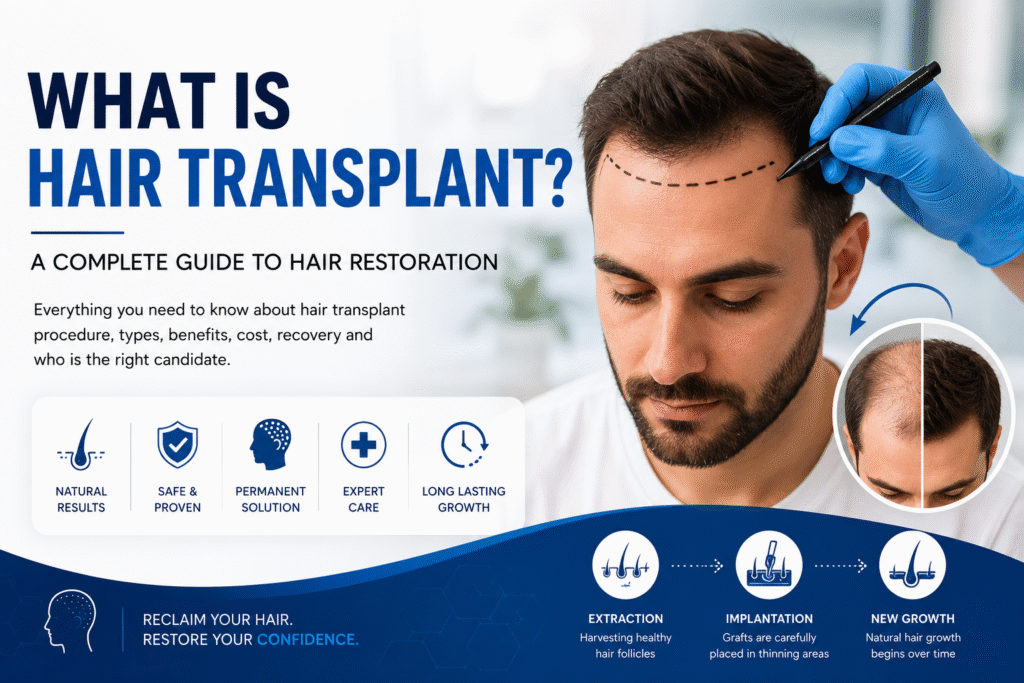

Hair loss is a common concern that can affect both men and women. While losing a small amount of hair every day is normal, excessive hair thinning or permanent baldness can become a concern for many people. Genetics, ageing, hormonal changes, certain medical conditions, and other factors may contribute to hair loss.
For people experiencing certain types of permanent hair loss, a hair transplant may be considered as a surgical hair restoration option. Modern hair transplant procedures involve relocating healthy hair follicles from one part of the scalp to areas where the hair has become thin or bald.
But what exactly is a hair transplant, how does the procedure work, and what should you know before considering one? Here’s a simple guide.
What Is a Hair Transplant?
A hair transplant is a cosmetic surgical procedure in which healthy hair follicles are moved from a donor area to an area experiencing permanent hair loss or thinning.
The donor area is commonly located at the back or sides of the scalp, where hair may be more resistant to the effects of pattern hair loss. These follicles are carefully extracted and transplanted into the recipient area, such as the front hairline, temples, mid-scalp, or crown.
The goal of the procedure is to redistribute existing hair follicles to create improved coverage and a natural-looking appearance.
It’s important to understand that a hair transplant doesn’t create new hair follicles. Instead, it relocates suitable follicles from one part of the scalp to another. Therefore, the quality and availability of donor hair play an important role in determining whether someone may be a suitable candidate.
How Does a Hair Transplant Work?
The hair transplant process begins with a consultation. A qualified medical professional evaluates the patient’s hair loss pattern, donor area, scalp condition, medical history, and expectations.
If the patient is considered suitable for surgery, a personalised treatment plan is developed.
The procedure generally involves three main stages.
1. Donor Hair Extraction
Healthy hair follicles are harvested from the selected donor region. The method used to collect these follicles depends on the chosen hair transplant technique.
Careful donor management is essential because the number of suitable donor follicles is limited.
2. Graft Preparation
After extraction, the harvested follicular units are carefully handled and prepared for transplantation.
Proper graft handling is an important part of the procedure because the follicles need to remain viable before implantation.
3. Hair Follicle Implantation
The extracted grafts are implanted into the recipient area according to the planned hairline and density distribution.
The surgeon must consider the natural angle, direction, and pattern of hair growth. Careful planning can help create a result that blends naturally with the patient’s existing hair.
Types of Hair Transplant Procedures
Different hair transplant techniques are available. Two commonly discussed methods are FUE and FUT.
FUE Hair Transplant
FUE stands for Follicular Unit Extraction.
During an FUE procedure, individual follicular units are extracted from the donor area and later transplanted into the recipient region.
Because follicles are individually extracted, FUE doesn’t create the same type of long linear donor scar associated with strip surgery. However, it can leave multiple tiny extraction scars.
FUE has become a widely used hair transplantation technique and may be suitable for certain patients depending on their donor characteristics and treatment goals.
FUT Hair Transplant
FUT stands for Follicular Unit Transplantation.
With FUT, a strip of scalp containing healthy hair follicles is surgically removed from the donor region. The strip is then carefully divided into individual follicular units for transplantation.
Unlike FUE, FUT generally leaves a linear scar in the donor region.
The right technique depends on several individual factors. A qualified hair transplant surgeon should evaluate the patient and explain the advantages, limitations, and potential risks of each available option.
Who Is a Suitable Candidate for a Hair Transplant?
Not everyone experiencing hair loss is automatically a suitable candidate for hair transplantation.
A medical professional may consider factors such as:
- The type and cause of hair loss
- The stability and progression of hair loss
- The quality and density of donor hair
- The patient’s age and medical history
- Scalp characteristics
- Existing hair density
- Future hair loss risk
- Personal expectations
Men and women experiencing certain forms of pattern hair loss may be considered for transplantation if they have an adequate donor supply.
However, some types of hair loss may require medical investigation or non-surgical management instead.
Getting an accurate diagnosis before deciding on surgery is therefore essential.
What Are the Potential Benefits of Hair Transplantation?
For appropriately selected patients, hair transplantation may offer several potential benefits.
One major advantage is that transplanted follicles can continue producing hair after successful transplantation. Because the procedure uses the patient’s own hair follicles, the new growth can blend with existing hair.
A well-planned procedure may also improve the appearance of areas affected by permanent hair loss.
Potential benefits include:
- Natural-looking hair restoration
- Improved coverage of thinning or bald areas
- Personalised hairline design
- Use of the patient’s own hair follicles
- Potentially long-lasting hair growth
However, individual results vary. The quality of the donor area, surgical technique, surgeon’s expertise, ongoing hair loss, and biological factors can all influence the final outcome.
How Long Does Hair Transplant Recovery Take?
Recovery varies between individuals and depends partly on the extent and technique of the procedure.
During the early recovery period, some patients may experience temporary redness, swelling, tenderness, or crusting around the treated areas.
Transplanted hairs may also shed during the weeks following the procedure. New hair growth generally develops gradually rather than immediately.
Patients should follow all post-operative instructions provided by their medical team. These may include guidance about washing the scalp, sleeping position, exercise, sun exposure, and medication.
Visible improvement can take several months, while the transplanted hair may continue to mature over a longer period.
Are There Any Risks?
Hair transplantation is a surgical procedure and therefore carries potential risks.
Possible complications may include infection, bleeding, swelling, scarring, temporary numbness, inflammation around hair follicles, poor graft growth, or an unnatural appearance.
Existing non-transplanted hair may also continue to thin over time.
Choosing an appropriately qualified and experienced medical professional and following post-operative instructions can help reduce avoidable risks.
How Much Does a Hair Transplant Cost?
The cost of a hair transplant varies significantly depending on several factors.
These may include the number of grafts required, the chosen technique, the surgeon’s expertise, the complexity of the procedure, the clinic’s location, and the services included in the treatment package.
Rather than selecting a clinic based only on the lowest price, patients should consider medical qualifications, experience, hygiene standards, treatment planning, and aftercare.
A detailed consultation is generally necessary to receive an accurate cost estimate.